


Showing posts with label general. Show all posts
i.Dummy for shopping

The Hong Kong Polytechnic University is well known for her clothing and textile research and technologies. This time, she introduces "i.Dummy" - a smart fitting model.
The apparel industry relies very much on the "mannequin" for many tasks involved in apparel design, fitting and alteration, and size gradation. However, traditional mannequins (only one size per mannequin) are costly and occupy a lot of storage space. Developed to solve the problem of having multiple sized mannequins, the "i.Dummy" can flexibly change to any shape and dimensions as required by the designer. It is a "multi-able" entity (adjustable, expandable, contractible, and variable) which can solve the many problems of designing and fitting of tailored clothing or ready-to-wear.
extracted from
http://www.polyu.edu.hk/web/en/media/media_releases/index_id_6108.html
This innovation win the Grandprice and Gold medal in at the 43rd International Exhibition of Inventions of Geneva.
More about i.Dummy:
I.DUMMY, the new breakthrough in mannequin technology, was acheived by the Hong Kong Poly Technic University in 2013. The project was led by Dr Allan Chan Chee-kooi, Associate Professor at PolyU's Institute of Textiles and Clothing (ITC), with team members. Applying advanced mechatronics technology as the platform of mannequin development, Dr Allan Chan and his team members collected massive anthropometric data from worldwide population, as well as actual body scales from 3D Body Scanner, to create I.DUMMY's universal body scales and sizes. Understanding the new fitting revolution has come, Winswin acquired the techology, refined and brings it into the market. I.DUMMY will assist our keenly sensitive fashion partners to fit in the new era
- extracted from http://www.idummy.com
More about Prof. Chan Chee-kooi:

image source: http://www.idummy.com,
http://pixshark.com/vintage-fashion-mannequin.htm
Unlock your Mobile phone with your EAR !!

Yahoo Labs presents Bodyprint, an authentication system, to unlock your smartphone!
"Bodyprint brings biometric authentication to commodity mobile devices using the capacitive touchscreen as a low-resolution, but large-area image sensor to reliably identify users based on their ears, fists, or grips when pressed against the touchscreen. "
http://www.christianholz.net/bodyprint.html
Beside your ears, you can use other body parts, fingers, fists, and palms by pressing them against the display.

See how it work on Youtube:
Bodyprint: Biometric Authentication on Smartphones using the Touchscreen as a Scanner
image source: http://www.christianholz.net/bodyprint.html
Solar Power on Water
Japan built all solar panels on water!

"Two floating mega-solar power plants at Nishihira Pond and Higashihira Pond in Kato City, Hyogo Prefecture, Japan. The plants, inaugurated in late March, will generate an estimated 3,300 megawatt hours (MWh) per year in total-- enough electricity to power approximately 920 typical households"
Why on Water?
The company claims that:
How it float?

Image source: http://global.kyocera.com/
"Two floating mega-solar power plants at Nishihira Pond and Higashihira Pond in Kato City, Hyogo Prefecture, Japan. The plants, inaugurated in late March, will generate an estimated 3,300 megawatt hours (MWh) per year in total-- enough electricity to power approximately 920 typical households"
Why on Water?
The company claims that:
- Floating solar power generating systems typically generate more electricity than ground-mount and rooftop systems due to the cooling effect of the water.
- They reduce reservoir water evaporation and algae growth by shading the water.
- Floating platforms are 100% recyclable, utilizing high-density polyethylene, which can withstand ultraviolet rays and resists corrosion.
- The floating platforms are designed and engineered to withstand extreme physical stress, including typhoon conditions
How it float?

Image source: http://global.kyocera.com/
Tag :
general,
DNA Day 2015

"In April 1953, the paper by James Watson and Francis Crick describing the structure of DNA was published in the scientific journal Nature. With help from other scientists, Watson and Crick were the first to describe DNA as a double helix, or a twisted ladder shape. Notably, their model of DNA suggested how genetic information is stored and copied. DNA Day commemorates this important landmark in science."
Extracted from: http://ghr.nlm.nih.gov/spotlight/dna-day-2015
More about DNA DAY:
http://www.genome.gov/26525485
Full article of 1953 paper by Watson and Crick:
Molecular Structure of Deoxypentose Nucleic Acids
http://www.nature.com/nature/dna50/watsoncrick.pdf, Nature
Without a microscope, can you find DNA around you?


The Helix Bridge, 280-metre pedestrian linkway, Singaporehttp://www.yoursingapore.com/content/traveller/en/browse/see-and-do/arts-and-entertainment/architecture/helix-bridge.html


.jpg)
images source:
http://www.designrulz.com/design/2015/01/especially-weddings-ribbon-chapel-hiroshi-nakamura-hiroshima-japan/
https://diy.org/ogel/18925
Tag :
general,
Earth Day 2015!

Check it out here:
http://www.acs.org/content/acs/en/education/outreach/cced.html
For all kids and general public, the site shows you the relationship between chemistry of greenhouse gas, UV light, air particles and climate science:
http://www.acs.org/content/dam/acsorg/education/outreach/cced/2015-cced-brochure-online.pdf
I captured an interesting game below:

image source: ACS
Croucher Innovation Awards 2015

Congratulation!
Dr Tom Hiu Tung Cheung, Assistant Professor of the Division of Life Science, and Dr Kam Tuen Law, Assistant Professor of the Department of Physics at the Hong Kong University of Science and Technology (HKUST) were honored the prestigious Croucher Innovation Awards 2015 by the Croucher Foundation for their distinguished scientific research achievements. Each award carries a value of up to HK$5 million over five years.
Click here for the whole article:
Two HKUST Professors Honored The Croucher Innovation Awards 2015
More about Dr. Tom Hiu Tung Cheung
http://life-sci.ust.hk/faculty/Dr.T.H.Cheung/

More about Dr. Kam Tuen Law
http://physics.ust.hk/phlaw/

What is Croucher Foundation?
http://www.croucher.org.hk/
The Croucher Foundation is an independent private foundation established by the late Noel Croucher in 1979 to promote the standard of the natural sciences, technology and medicine in Hong Kong. The work of the Foundation is organised into five broad areas:
- scholarships and fellowships for promising young Hong Kong scientists and medical doctors to pursue research overseas;
- research fellowships to enable scientists in Hong Kong to pursue their intellectual inclinations, and to engage in bold new work;
- conferences, workshops and collaborative research to facilitate the exchange of ideas between Hong Kong scientists and their counterparts overseas;
- demonstration lectures to promote a wider understanding of science among Hong Kong school students and undergraduate students; and
- support for any undergraduate student in Hong Kong experiencing sudden financial difficulty.
image source: HKUST
Chemical engineering for your "sugar-free" ice-cream
A story about your daily life with chemical engineering - if you are ice-cream lovers.

This is a tasty story from University of Connecticut:
"Ice cream’s semi-solid state is the result of a fragile balance of ingredients, and it’s no easy trick to replace old-fashioned sugar and still get the rich taste and texture that makes the Creamery’s ice cream so popular."

Click here for the entire story:
Engineering Ice Cream, University of Connecticut
http://today.uconn.edu/blog/2015/04/engineering-ice-cream/
The following video reveals the real works in an ice-cream factory
This is a tasty story from University of Connecticut:
"Ice cream’s semi-solid state is the result of a fragile balance of ingredients, and it’s no easy trick to replace old-fashioned sugar and still get the rich taste and texture that makes the Creamery’s ice cream so popular."
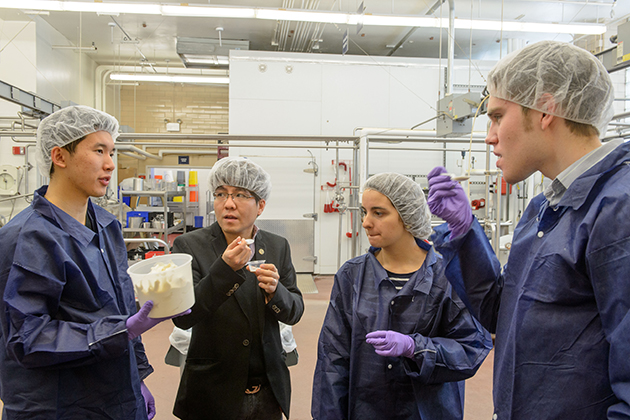
Click here for the entire story:
Engineering Ice Cream, University of Connecticut
http://today.uconn.edu/blog/2015/04/engineering-ice-cream/
The following video reveals the real works in an ice-cream factory
Inside the Blue Bell Ice Cream Factory
Image source: Youtube
About DNA sequence industry: Welcome to the $1,000 genome: on Illumina and next-gen sequencing

Recently I found a news from Illumina, the leading DNA sequencing technology provider about two new sequencing machines. In the article, Mark Wation from The Roslin Institute, University of Edinburgh, gives his insight about the state-of-art of DNA sequencing and its future tends: Welcome to the $1,000 genome: on Illumina and next-gen sequencing
<More about Mick Watson>

I extracted a small part of the article below:
The future for Illumina’s competitors
It will be really interesting to see how Life Technologies responds to Illumina’s latest developments. Their key advantage is speed, with the Ion Torrent platforms carrying out the sequencing component in hours rather than days. However, the throughput and cost-per-base do not match current Illumina platforms, never mind the new ones. To remain a viable business, Life Technologies, and its Ion Torrent platforms, must respond.
Pacific Biosciences’ SMRT technology has evolved significantly too and has become an essential tool for those wishing to close genomes, or sequence de novo new genomes. Intriguingly, Roche, a global health-care company, announced an agreement with Pacific Biosciences to develop DNA sequencing products for clinical diagnostics. This is not a space that Pacific Biosciences have been in up until now, and it is difficult to see how their RS II system can compete with Illumina and Ion Torrent in the clinic. Because of this, rumors of a new (benchtop?) PacBio machine abound on social media.
For many, Oxford Nanopore Technologies, heir apparent to the sequencing crown, remain the future. The company recently opened up an early-access program for their USB sequencer, the MinION. At the AGBT conference, David Jaffe showed the first data from this platform. These are exciting times for nanopore-based sequencing, but there remain challenges – particularly in interpreting the signal and turning it into the ‘bases + quality scores’ paradigm that many are used to. In fact, to get the best out of the platform, many think a change to the above paradigm will need to happen, and software may need to interpret the raw signal rather than the traditional 4 bases. On his blog, Yaniv Erlich commented that ‘MinION is not a sequencing platform. It is a sequencing sensor.’ (his italics) and I think this is a key differentiator of the platform. It is the only platform that detects an actual single strand of DNA (rather than incorporation events as a template strand is copied), and it still astounds me to think that we are soon to have in our hands the very first mobile device capable of sequencing DNA – surely an historic moment. With that idea in mind, it is hard not to believe that nanopore-based sequencing is the future. Of course, Oxford Nanopore have competitors, but one look at their management team, followed by a look at their IP portfolio, and it is hard to imagine anyone being better placed to deliver on the promises of nanopore-based sequencing.
image source: All Things Illumina Sequencing Methods
the Year of goat, NOT ‘any ruminant horned animal’ ??

An interesting article:
also see here:

"The Chinese word yang in oracle-bone script - the ancient characters found on bones used for divination in the Bronze Age - looked like an animal with two horns and a pointy face, said Professor Ho Che-wah, head of the department of Chinese literature at Chinese University.
But the character could be translated to goat, sheep or ram in English.
Ho said that while sheep had a long history in Chinese society, the country's culinary past suggested the goat as the most likely animal to have been included in the zodiac.
"In ancient China, people ate six types of animals - horse, cow, goat, pig, dog and chicken. Goat is therefore included in the zodiac, too," Ho said.
Goats also had a higher status among the six animals in Chinese society, as in the past, only rich people and the aristocracy could afford to eat them.
The Chinese word for "envy" originally referred to a person salivating over a goat, Ho added."
“gung1 hei2 faat3 coi4”
Tag :
general,
Geoengineering - technology against our nature?

There is an interesting article on BBC-science/environment recently titled "'Next Pinatubo' a test of geoengineering" and Prof. Alan Robock from Rutgers University shared his viewpoints about this.
One topic being discussed is to take advantage of next big volcanic eruption to study sulphur dioxide how it could help against global warming. Enjoy it.
The article also points out that this is a plan Z in case there is no remarkable outcome to reduce greenhouse gas emission.
About Prof. Alan Robock
related infographcis:


Youtube about Geoengineering:
image source: The pros and cons of geoengineering
biochemistry or chemical biology?

What is Chemical Biology? and
What is Biochemistry?
I extracted the following description from a RSC book, New Frontiers in Chemical Biology
"Chemical biology is an emerging field at the interface between chemistry and biology. It utilises the tools and techniques of chemical synthesis to study and influence biological systems. Recent developments in this area have great potential in addressing the productivity challenges expressed above. For example, chemical biology studies have already led to the identification of novel targets with exciting therapeutic potential and it is clear that the field will prove a key enabler of target discovery in the future. Moreover, the precise synthetic manipulation of biological molecules involved in many chemical biology approaches is now fuelling a new wave of chemically-modified biologics, 'chemologics', with unique properties. In these, and many other ways, chemical biology is a key discipline within 21st century drug discovery and the purpose of this book is to highlight the most important developments. It provides a valuable resource for scientists in academia and industry who are looking to build their knowledge of this hot topic."
You may get more ideas from the following:
Institute of Chemical Biology, Imperial College.
Chemical Biology Graduate @ UC Berkeley
Chemical Biology PHD Program
To review what is biochemistry, try Biochemical Society.
Its booklet describes what is biochemistry:
http://www.biochemistry.org/Portals/0/Education/Docs/Biochem_Booklet_web.pdf
"explore the chemical process that take place inside all living things, from bacteria to plants and animals"
image source: The Chemistry-Biology Interface Training Program
Tag :
general,
Cars without Driver

There is an interesting article about driverless cars in Nature recently - Autonomous vehicles: No drivers required. In the first line, it states that:
"This summer, people will cruise through the streets of Greenwich, UK, in electric shuttles with no one's hands on the steering wheel — or any steering wheel at all."
No need to be scare when you find a moving car without a driver.
Btw, this is not a new things. Google Driverless Project may give you more confident on driverless technology. Take a look here:
A Ride in the Google Self Driving Car
A First Drive
related news:
Ten ways that driverless cars will change the world, the Telegraph

There is a good academic reference for you, edited by Prof. Azim Eskandarian:

I hope the test in UK works and it will be a good news for all travelers without driving licence. Anyway, this news remind me the Google Driverless project.
image source: Autonomous vehicles: No drivers required
Tag :
general,
Nanyang Technological University produced a 3D printed concept car

Of course this is not the first 3D printer car, but it is good to see a group of students from Nanyang Technological University to get it done.
They are NTU Venture 8 & NTU Venture 9, both with round 150 parts are 3D-pritned.
For the NTU Venture 8, honeycomb structure and a unique joint design was employed, to ensure the car doesn't come apart. Also, the car chassis is see-through when hit by the light at the right angle. Presumably, most of the light will be absorbed by the solar cells so that the inside of the car doesn't heat up overmuch during summer.

NTU Venture (NV) 9, a slick three-wheeled racer which can take sharp corners with little loss in speed due to its unique tilting ability inspired by motorcycle racing.

NTU unveils Singapore’s first 3D-printed concept car
3D-printed green vehicle to blaze a trail for future car technology
This first 3D printed car is like this:
image source: straitstimes
Alibaba sets up HK$1b fund to help young Hong Kong entrepreneurs

From South China Morning Post, Monday 02, Feb, 2015
image source: http://www.cmoney.tw/notes/note-detail.aspx?nid=22713