


Crowdfunding the Azolla fern genome project: a grassroots approach
* Corresponding author: Fay-Wei Li fay.wei.li@duke.edu
Department of Biology, Duke University, Durham, North Carolina 27708, USA
GigaScience 2014, 3:16 doi:10.1186/2047-217X-3-16

Main text
Our Azolla crowdfunding campaign
The ultimate goal of crowdfunding is to garner sufficient interest and enthusiasm from a large enough group of people over the Internet, so that they feel compelled to provide some measure of funding toward your project. Reaching out and convincing a total stranger more than 6,000 miles away to pitch in sounds like a daunting task, and indeed it was. We struggled and learned a lot as we went along.
For the past five years, people have been using websites, such as Kickstarter and Indiegogo, to crowdfund their creative arts, tech or gaming projects. We chose a relatively new platform, Experiment.com, because it is completely science oriented. One potential drawback is that Experiment has a much narrower audience compared to those of the large and hyper-diverse Kickstarter or Indiegogo platforms; therefore, one’s project could have less visibility to potential backers from outside of science. At Experiment, we set our campaign duration to 40 days and our funding goal to $15,000, with an objective to be able to draft an Azolla genome with 100X coverage [12].
Within our first naïve moments of launching the campaign, we seriously thought we could just kick off our shoes, sit back and watch the cash flow in. Well, we were completely mistaken. It was the start of a constant marathon of social media networking through email, Twitter, Facebook, and other resources we had never heard of before. Based on our experience, there are at least three major social network layers that one needs to penetrate. The first layer comprises immediate families, friends and colleagues; happily they were also among the first to donate (thanks Mom!). We asked them to tell their friends, families and colleagues so that we could extend our reach to the second layer—acquaintances. By repeating and extending this cycle, eventually our message reached the most important third layer, consisting of complete outsiders.
Into the second week of our crowdfunding campaign, we discovered the power of Reddit, an online news hub and discussion forum with enormous visitor traffic. We did a Reddit Science AMA (Ask Me Anything), where anyone could ask us any question in one afternoon about Azolla, ferns, plants—even career advice! We answered more than 200 questions that afternoon and got over 3,000 “upvotes”. The number of visitors to our crowdfunding website spiked during that afternoon and the following two days. To reach out and directly communicate with a broad and diverse audience, a Reddit AMA is something we highly recommend.
Obviously, not everyone surfs Reddit, or keeps up with the latest trends on social networks. We therefore also reached out using a more traditional news medium: newspapers. At the urging of Duke University’s Office of News & Communications, the junior author wrote an op-ed stressing the importance of Azolla research. It was immediately picked up by Canada’s highest-circulating newspaper, The Toronto Globe and Mail, as well as the Contra Costa Times of the San Francisco Bay area [13]. A fair number of our backers were from Canada, which we believe can be attributed to the op-ed in The Globe and Mail.
As this momentum began to build, we were also fortunate enough to get serious attention from the “big guys”—The Economist, USA Today and Scientific American [13]—who all reported on our efforts. Such coverage, without a doubt, gave us a tremendous push.
⓿ The electronic version of this article is the complete one and can be found online at: http://www.gigasciencejournal.com/content/3/1/16
image source: http://www.gigasciencejournal.com/content/3/1/16
Department of Biology, Duke University, Durham, North Carolina 27708, USA
GigaScience 2014, 3:16 doi:10.1186/2047-217X-3-16
Main text
Our Azolla crowdfunding campaign
The ultimate goal of crowdfunding is to garner sufficient interest and enthusiasm from a large enough group of people over the Internet, so that they feel compelled to provide some measure of funding toward your project. Reaching out and convincing a total stranger more than 6,000 miles away to pitch in sounds like a daunting task, and indeed it was. We struggled and learned a lot as we went along.
For the past five years, people have been using websites, such as Kickstarter and Indiegogo, to crowdfund their creative arts, tech or gaming projects. We chose a relatively new platform, Experiment.com, because it is completely science oriented. One potential drawback is that Experiment has a much narrower audience compared to those of the large and hyper-diverse Kickstarter or Indiegogo platforms; therefore, one’s project could have less visibility to potential backers from outside of science. At Experiment, we set our campaign duration to 40 days and our funding goal to $15,000, with an objective to be able to draft an Azolla genome with 100X coverage [12].
Within our first naïve moments of launching the campaign, we seriously thought we could just kick off our shoes, sit back and watch the cash flow in. Well, we were completely mistaken. It was the start of a constant marathon of social media networking through email, Twitter, Facebook, and other resources we had never heard of before. Based on our experience, there are at least three major social network layers that one needs to penetrate. The first layer comprises immediate families, friends and colleagues; happily they were also among the first to donate (thanks Mom!). We asked them to tell their friends, families and colleagues so that we could extend our reach to the second layer—acquaintances. By repeating and extending this cycle, eventually our message reached the most important third layer, consisting of complete outsiders.
Into the second week of our crowdfunding campaign, we discovered the power of Reddit, an online news hub and discussion forum with enormous visitor traffic. We did a Reddit Science AMA (Ask Me Anything), where anyone could ask us any question in one afternoon about Azolla, ferns, plants—even career advice! We answered more than 200 questions that afternoon and got over 3,000 “upvotes”. The number of visitors to our crowdfunding website spiked during that afternoon and the following two days. To reach out and directly communicate with a broad and diverse audience, a Reddit AMA is something we highly recommend.
Obviously, not everyone surfs Reddit, or keeps up with the latest trends on social networks. We therefore also reached out using a more traditional news medium: newspapers. At the urging of Duke University’s Office of News & Communications, the junior author wrote an op-ed stressing the importance of Azolla research. It was immediately picked up by Canada’s highest-circulating newspaper, The Toronto Globe and Mail, as well as the Contra Costa Times of the San Francisco Bay area [13]. A fair number of our backers were from Canada, which we believe can be attributed to the op-ed in The Globe and Mail.
As this momentum began to build, we were also fortunate enough to get serious attention from the “big guys”—The Economist, USA Today and Scientific American [13]—who all reported on our efforts. Such coverage, without a doubt, gave us a tremendous push.
⓿ The electronic version of this article is the complete one and can be found online at: http://www.gigasciencejournal.com/content/3/1/16
image source: http://www.gigasciencejournal.com/content/3/1/16
Tag :
biomedcentral,
general,
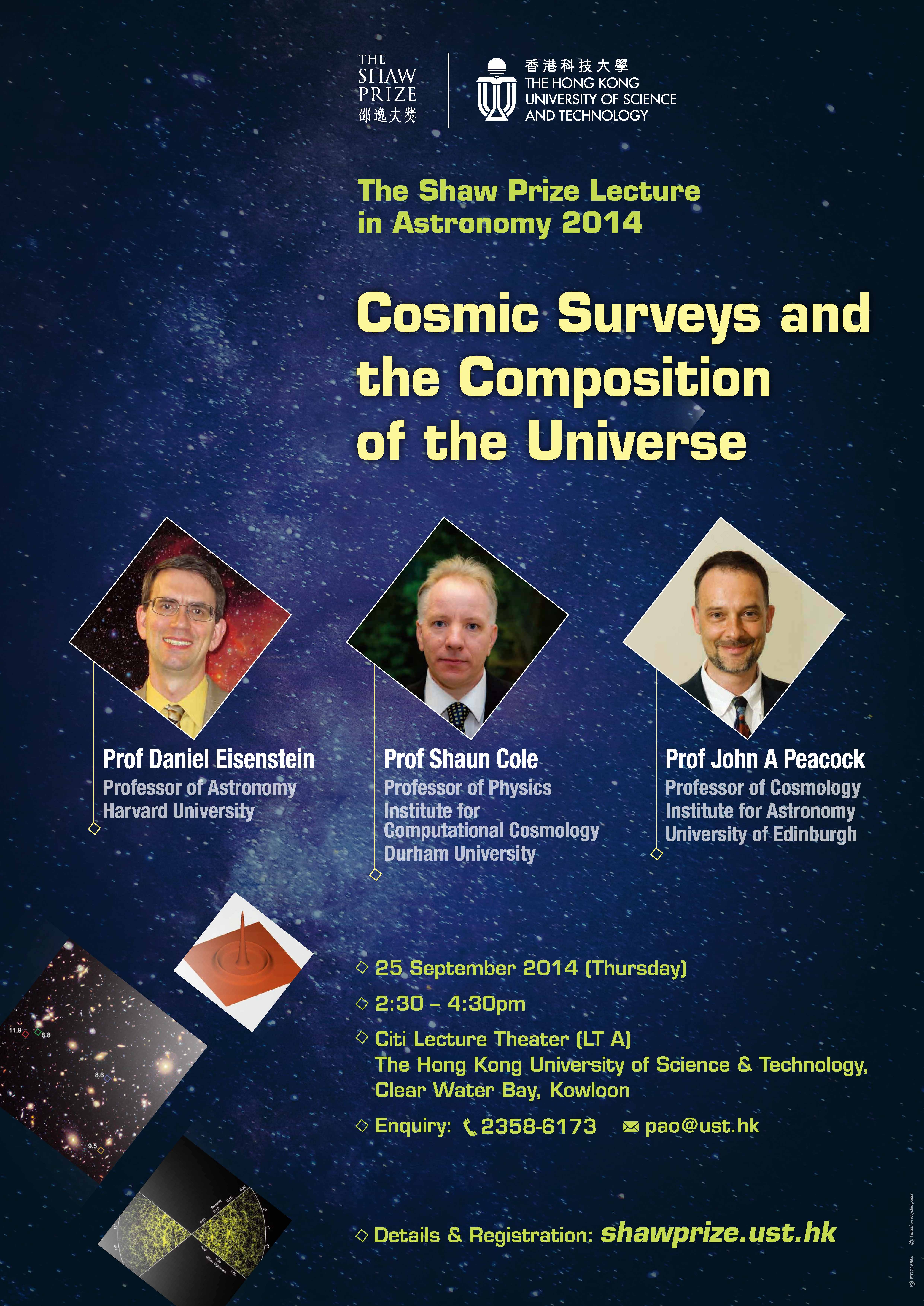
Shaw Prize 2014 || Astronomy || Life Science & Medicine || Mathematical Science
Congratulation to all recipient of Shaw Prize 2014!

For more information: www.shawprize.org
Astronomy
- Daniel Eisenstein
- Shaun Cole
- John A Peacock
"for their contributions to the measurements of features in the large-scale structure of galaxies used to constrain the cosmological model including baryon acoustic oscillations and redshift-space distortions."
Life Science & Medicine
- Kazutoshi Mori
- Peter Walter
"for their discovery of the Unfolded Protein Response of the endoplasmic reticulum, a cell signalling pathway that controls organelle homeostasis and quality of protein export in eukaryotic cells."

Mathematical Sciences
- George Lusztig
"for his fundamental contributions to algebra, algebraic geometry, and representation theory, and for weaving these subjects together to solve old problems and reveal beautiful new connections."

image source: http://www.shawprize.org/
Tag :
general,
Why Systems Chemistry?
Corresponding author: Günter von Kiedrowski kiedro@rub.de
Bioorganic Chemistry, Ruhr University, Bochum, Germany
<More about author>
Journal of Systems Chemistry 2010, 1:1 doi:10.1186/1759-2208-1-1

Why Systems Chemistry?
Synthesis and design is per se a chemical endeavor - but the goal of synthesis in chemistry is usually a chemical structure. On the other hand, the design and synthesis of complex dynamic behavior in chemical systems is as much in its infant shoes as the reduction and reconstruction approach of synthetic biology. It is a challenge (if not the challenge) for the chemistry of the 21st century. Let us now try to generalize the challenges that face Systems Chemistry in the near future. Systems chemistry seeks to combine the "classical" knowledge of chemistry, viz. the language of molecules, their structures, their reactions and interactions, together with the "classical" knowledge derived from existing forms of life. One component of this approach, acting both as a translator and abstractor between these languages comes from the fields of theoretical biology and complex systems research; the other key component comes from a chemistry that is the offspring of both supramolecular and prebiotic chemistry, and adds a new dimension that has not been sufficiently addressed so far. Over the past decades more and more chemists have learned to design and implement chemical systems showing emergent behavior, such as simple self-replicating and self-reproducing systems, chiral symmetry breaking reactions, as well as far-from-equilibrium self-organizing systems (i.e. oscillating reactions , Turing patterns) and today we even have the first examples of systems chemistry making molecular motors [69]. For a more detailed description of some recent highlights in systems chemistry from a more supramolecular perspective, see ref [70]. What is missing here is a kind of generalization of "synthetic methods" based on the principles of autocatalysis, supramolecular self-organization, molecular information processing, and moreover, applicable in the range from small molecules via nano- to mesosystems. Before we will be able to come to such generalizations, many more studies of the complex/emergent behavior of chemical systems are required. The analytical tools have now become accessible to most chemists to be able to set off and explore the largely uncharted territory of chemistry at systems level. The discoveries and new insights that this territory holds in store require a forum for dissemination. The Journal of Systems Chemistry has been set up for this purpose at a time that Systems Chemistry starts to resonate with an increasingly large number of chemists, biologists, physicists and computer scientists.
⓿ The electronic version of this article is the complete one and can be found online at: http://www.jsystchem.com/content/1/1/1
Bioorganic Chemistry, Ruhr University, Bochum, Germany
<More about author>
Journal of Systems Chemistry 2010, 1:1 doi:10.1186/1759-2208-1-1
Why Systems Chemistry?
Synthesis and design is per se a chemical endeavor - but the goal of synthesis in chemistry is usually a chemical structure. On the other hand, the design and synthesis of complex dynamic behavior in chemical systems is as much in its infant shoes as the reduction and reconstruction approach of synthetic biology. It is a challenge (if not the challenge) for the chemistry of the 21st century. Let us now try to generalize the challenges that face Systems Chemistry in the near future. Systems chemistry seeks to combine the "classical" knowledge of chemistry, viz. the language of molecules, their structures, their reactions and interactions, together with the "classical" knowledge derived from existing forms of life. One component of this approach, acting both as a translator and abstractor between these languages comes from the fields of theoretical biology and complex systems research; the other key component comes from a chemistry that is the offspring of both supramolecular and prebiotic chemistry, and adds a new dimension that has not been sufficiently addressed so far. Over the past decades more and more chemists have learned to design and implement chemical systems showing emergent behavior, such as simple self-replicating and self-reproducing systems, chiral symmetry breaking reactions, as well as far-from-equilibrium self-organizing systems (i.e. oscillating reactions , Turing patterns) and today we even have the first examples of systems chemistry making molecular motors [69]. For a more detailed description of some recent highlights in systems chemistry from a more supramolecular perspective, see ref [70]. What is missing here is a kind of generalization of "synthetic methods" based on the principles of autocatalysis, supramolecular self-organization, molecular information processing, and moreover, applicable in the range from small molecules via nano- to mesosystems. Before we will be able to come to such generalizations, many more studies of the complex/emergent behavior of chemical systems are required. The analytical tools have now become accessible to most chemists to be able to set off and explore the largely uncharted territory of chemistry at systems level. The discoveries and new insights that this territory holds in store require a forum for dissemination. The Journal of Systems Chemistry has been set up for this purpose at a time that Systems Chemistry starts to resonate with an increasingly large number of chemists, biologists, physicists and computer scientists.
⓿ The electronic version of this article is the complete one and can be found online at: http://www.jsystchem.com/content/1/1/1
Molecular mimicry, inflammatory bowel disease, and the vaccine safety debate
Corresponding author: Susy Yusung syusung@labiomed.org
Department of Pediatrics, Harbor-UCLA Medical Center, 1000 W Carson St, Torrance 90502, CA, USA
BMC Medicine 2014, 12:166 doi:10.1186/s12916-014-0166-6

Background
Measles virus is a highly contagious organism that can cause multiple organ system complications and even death. Introduction of the measles, mumps, rubella (MMR) vaccine in the 1970s has saved innumerable lives and attenuated severe morbidities globally. Despite these remarkable gains, a claim emerged in the 1990s which associated MMR vaccine with colitis and autism spectrum disorders [1]-[4]. These association studies have been recognized as methodologically flawed and in some instances factually erroneous by the scientific and medical communities [5]. However, doubt and even outright rejection of the vaccine’s safety still linger in various niches of our society. These concerns have also reverberated in the inflammatory bowel disease (IBD) community, in part related to the publication of a study series implying measles infection or vaccination with the live attenuated virus mediate pathogenesis of Crohn’s disease (CD) [3],[4],[6]. Despite recognition that these studies were flawed in methodology and hypothesis, they continue to provoke much debate and inquiry into the role of measles virus in the pathogenesis of IBD.
⓿ The electronic version of this article is the complete one and can be found online at: http://www.biomedcentral.com/1741-7015/12/166
image source: http://www.nytimes.com/2009/05/19/science/19vacc.html?pagewanted=all
Department of Pediatrics, Harbor-UCLA Medical Center, 1000 W Carson St, Torrance 90502, CA, USA
BMC Medicine 2014, 12:166 doi:10.1186/s12916-014-0166-6
Background
Measles virus is a highly contagious organism that can cause multiple organ system complications and even death. Introduction of the measles, mumps, rubella (MMR) vaccine in the 1970s has saved innumerable lives and attenuated severe morbidities globally. Despite these remarkable gains, a claim emerged in the 1990s which associated MMR vaccine with colitis and autism spectrum disorders [1]-[4]. These association studies have been recognized as methodologically flawed and in some instances factually erroneous by the scientific and medical communities [5]. However, doubt and even outright rejection of the vaccine’s safety still linger in various niches of our society. These concerns have also reverberated in the inflammatory bowel disease (IBD) community, in part related to the publication of a study series implying measles infection or vaccination with the live attenuated virus mediate pathogenesis of Crohn’s disease (CD) [3],[4],[6]. Despite recognition that these studies were flawed in methodology and hypothesis, they continue to provoke much debate and inquiry into the role of measles virus in the pathogenesis of IBD.
⓿ The electronic version of this article is the complete one and can be found online at: http://www.biomedcentral.com/1741-7015/12/166
image source: http://www.nytimes.com/2009/05/19/science/19vacc.html?pagewanted=all
What is gutter oil 地溝油?
Gutter oil (地溝油) is recently one of the hottest topics in Taiwan, Hong Kong, and Macau. Related news have been reported almost everyday...
Related news:
Taiwan’s ‘Gutter Oil’ Scandal, The New York Times
Taiwan gutter oil scandal spreads to Hong Kong, Business Insider
China probes 'gutter oil in medicine' claims, BBC News

Gutter oil = germy + carcinogenic
Gutter oil, or illegal cooking oil, is secondhand oil refined from cooking waste, gutters, drains, and animal fat. Through a series of simple processes, such as collection, preliminary filtration and boiling, refining, and the removal of adulterants, illegal gutter oil is packed and sold to low-end restaurants
Gutter oil may contain toxic substances ranging from harmful bacteria to heavy metals and fatty acids. The illegal use of gutter oil as cooking oil raised the food safety fear once again in these regions.
Take a quick look on Youtube "Gutter oil: explained"
Related news:
Taiwan’s ‘Gutter Oil’ Scandal, The New York Times
Taiwan gutter oil scandal spreads to Hong Kong, Business Insider
China probes 'gutter oil in medicine' claims, BBC News
Gutter oil = germy + carcinogenic
Gutter oil, or illegal cooking oil, is secondhand oil refined from cooking waste, gutters, drains, and animal fat. Through a series of simple processes, such as collection, preliminary filtration and boiling, refining, and the removal of adulterants, illegal gutter oil is packed and sold to low-end restaurants
Gutter oil may contain toxic substances ranging from harmful bacteria to heavy metals and fatty acids. The illegal use of gutter oil as cooking oil raised the food safety fear once again in these regions.
Take a quick look on Youtube "Gutter oil: explained"
Advancing the application of systems thinking in health
Correspondence: Taghreed Adam adamt@who.int
Alliance for Health Policy and Systems Research, World Health Organization, 1211, Geneva 27, Switzerland
Health Research Policy and Systems 2014, 12:50 doi:10.1186/1478-4505-12-50

"Systems thinking is, foremost, a mindset that views systems and their sub-components as intimately interrelated and connected to each other, believing that mastering our understanding of how things work lies in interpreting interrelationships and interactions within and between systems [1,3,4]. It is a perspective that deliberately goes beyond events, to look for patterns of behavior and the underlying systemic interrelationships which are responsible for these patterns and their associated events [5]. It embraces the understanding of open systems as complex adaptive systems that are constantly changing, resistant to change, counter-intuitive, non-linear, and where the whole is greater than the sum of the parts [3]."
"The Alliance for Health Policy and Systems Research (hereafter called the Alliance) has been one of the avid advocates for moving this kind of thinking forward, dedicating a number of activities and resources to promote this field among health practitioners and researchers. First, through its flagship publication on “Systems Thinking for Health Systems Strengthening” in 2009 [5], followed by a Journal Supplement in Health Policy and Planning, in 2012, it has sought to generate better understanding of current practices in applying systems thinking for health systems in LMICs [1].
The 2012 supplement demonstrated the dearth of applications that explicitly took into account the complexity and dynamics resulting from intervening in health systems, including evaluations of interventions with system-wide effects [2]. In addition, the very few applications that existed at the time of developing that supplement were predominately from high income countries [1]. These observations revealed the need for concerted efforts to advance the application of systems thinking in health, particularly in LMICs.
In March 2013, the Alliance, in collaboration with Canada’s International Development Research Centre, launched a Call for papers inviting teams of researchers and health practitioners, with particular focus on lead authorship from LMICs, to develop and share applications of systems thinking methods and approaches, culminating in this Series. This whole program of work, which spanned over two and a half years, provided a great opportunity for strengthening programs, policies, and methods in LMICs to enable researchers and decision makers to think through how systems thinking approaches can be applied to their current health systems questions with practical results.
It is worth noting that, while this collection of articles offers innovative and diverse range of applications of systems thinking approaches, methods, and tools, as the Commentary by Peters illustrates [6], these applications by no means capture the entire range of relevant tools and approaches that can be applied."
# The complete electronic version of this article can be found online at: http://www.health-policy-systems.com/content/12/1/50
Alliance for Health Policy and Systems Research, World Health Organization, 1211, Geneva 27, Switzerland
Health Research Policy and Systems 2014, 12:50 doi:10.1186/1478-4505-12-50
"Systems thinking is, foremost, a mindset that views systems and their sub-components as intimately interrelated and connected to each other, believing that mastering our understanding of how things work lies in interpreting interrelationships and interactions within and between systems [1,3,4]. It is a perspective that deliberately goes beyond events, to look for patterns of behavior and the underlying systemic interrelationships which are responsible for these patterns and their associated events [5]. It embraces the understanding of open systems as complex adaptive systems that are constantly changing, resistant to change, counter-intuitive, non-linear, and where the whole is greater than the sum of the parts [3]."
"The Alliance for Health Policy and Systems Research (hereafter called the Alliance) has been one of the avid advocates for moving this kind of thinking forward, dedicating a number of activities and resources to promote this field among health practitioners and researchers. First, through its flagship publication on “Systems Thinking for Health Systems Strengthening” in 2009 [5], followed by a Journal Supplement in Health Policy and Planning, in 2012, it has sought to generate better understanding of current practices in applying systems thinking for health systems in LMICs [1].
The 2012 supplement demonstrated the dearth of applications that explicitly took into account the complexity and dynamics resulting from intervening in health systems, including evaluations of interventions with system-wide effects [2]. In addition, the very few applications that existed at the time of developing that supplement were predominately from high income countries [1]. These observations revealed the need for concerted efforts to advance the application of systems thinking in health, particularly in LMICs.
In March 2013, the Alliance, in collaboration with Canada’s International Development Research Centre, launched a Call for papers inviting teams of researchers and health practitioners, with particular focus on lead authorship from LMICs, to develop and share applications of systems thinking methods and approaches, culminating in this Series. This whole program of work, which spanned over two and a half years, provided a great opportunity for strengthening programs, policies, and methods in LMICs to enable researchers and decision makers to think through how systems thinking approaches can be applied to their current health systems questions with practical results.
It is worth noting that, while this collection of articles offers innovative and diverse range of applications of systems thinking approaches, methods, and tools, as the Commentary by Peters illustrates [6], these applications by no means capture the entire range of relevant tools and approaches that can be applied."
# The complete electronic version of this article can be found online at: http://www.health-policy-systems.com/content/12/1/50
Understand the Nature via BMC Ecology Image Competition 2014

Cool! Two hippos are are fighting. I got this image from BMC Ecology Image Competition 2014. There are lot more meaningful images for you to explore. Below are the overall all winner and runner-up...
Overall winner: “A Namaqua rock mouse (Aethomys namaquensis, Muridae) getting dusted with pollen of the Pagoda Lily (Whiteheadia bifolia, Hyacinthaceae) while lapping nectar at the flowers.”
Attribution: Petra Wester
Institute of Sensory Ecology, Heinrich-Heine-University Düsseldorf, German

"At first glance, this image of a Namaqua rock mouse (Aethomys namaquensis, Muridae) getting dusted with pollen of the Pagoda Lily (Whiteheadia bifolia, Hyacinthaceae) might not appear to be particularly striking. But this is an image that is much more than it at first appears. In contrast to last year’s winning image, of an evolutionary adaptation driven by the avoidance of death, this year’s winner offers a fascinating window into a highly unusual evolutionary game in which mutual benefits aid the struggle for survival and reproduction."
Overall runner-up: “Black-browed albatross (Thelassarche melanophrys) and chick on New Island (North-west Falkland I.). One aim of my work is monitoring the demography of these populations. Our objective is to follow the whole population during the different phases of the breeding season recording breeding pair success and fledgling success.”
Attribution: Letizia Campioni
Eco-Ethology Research Unit, ISPA, Portugal

"albatross—who often live to around 70 years of age—invest heavily in the survival of a single chick each year, regurgitating food until they are ready to fledge. The gorgeous detail of this image also serves to highlight fascinating adaptations to life foraging on the wing – the pronounced nostril, or naricorn, that guides saline solution from the salt gland, and the tooth-like structures at the base of the bill—all features for survival in a maritime environment"
image source: BMC Ecology image competition 2014: the winning images
Tag :
biomedcentral,
general,
What is Higgs boson?
Few days ago there was a news report about Higgs boson by Stephen Hawking - Stephen Hawking Fears Higgs Boson Doomsday, and He's Not Alone.

To understand what is Higgs boson, I tried to find more information on internet. The concept of Higgs boson is so difficult and hard to be explained to you and me, if you are not a physician neither, in a simple way.
The hidden symmetry and Mr. Higgs! - Cornell University Library, Open Access
The Higgs Particle: what is it, and why did it lead to a Nobel Prize in Physics? - Cornell University Library, Open Access
The Higgs: so simple yet so unnatural - Cornell University Library, Open Access
The Physics of the Higgs-like Boson - Cornell University Library, Open Access
Still no idea? try youtube...
The basics of the Higgs boson - Dave Barney and Steve Goldfarb
Higgs boson explained in 120 seconds - BBC Radio 4 - BBC News
image source: http://blog.sciencemuseum.org.uk/insight/tag/higgs-boson/
To understand what is Higgs boson, I tried to find more information on internet. The concept of Higgs boson is so difficult and hard to be explained to you and me, if you are not a physician neither, in a simple way.
The hidden symmetry and Mr. Higgs! - Cornell University Library, Open Access
The Higgs Particle: what is it, and why did it lead to a Nobel Prize in Physics? - Cornell University Library, Open Access
The Higgs: so simple yet so unnatural - Cornell University Library, Open Access
The Physics of the Higgs-like Boson - Cornell University Library, Open Access
Still no idea? try youtube...
The basics of the Higgs boson - Dave Barney and Steve Goldfarb
Higgs boson explained in 120 seconds - BBC Radio 4 - BBC News
The Hunt For Higgs - Documentary
CERN Experiment
Environmental stress and epigenetic transgenerational inheritance
Correspondence: Michael K Skinner skinner@wsu.edu
Center for Reproductive Biology, School of Biological Sciences, Washington State University, Pullman 99164-4236, WA, USA
More about author: skinner.wsu.edu/piskinner.html
BMC Medicine 2014, 12:153 doi:10.1186/s12916-014-0153-y

Background
The ability of environmental factors, such as stress [1], to promote the epigenetic transgenerational inheritance of disease and phenotypic variation has now been established in a number of organisms ranging from plants to humans, with a variety of environmental exposures [2]. One of the first studies found that environmental toxicants such as fungicides and pesticides promoted epigenetic transgenerational inheritance of reproductive disease [3]. Subsequently a large number of different types of toxicants (plastics, hydrocarbons, dioxin, biocides, dichlorodiphenyltrichloroethane (DDT)) have been shown to promote the transgenerational inheritance of disease [4] from obesity to cancer [5] (Table 1). Other critical environmental factors found to promote transgenerational disease are nutritional abnormalities such as caloric restriction or high fat diets [6]. In species such as insects and plants both drought and temperature have also been shown to be critical environmental factors [7],[8] (Table 1). Therefore, a large number of environmental factors have been shown to promote the epigenetic transgenerational inheritance of disease or phenotypic variation in a variety of different species, including humans [9]. This environmentally induced form of non-genetic inheritance will have a significant impact on disease etiology [2],[10] and areas of biology such as evolution [11].
Epigenetic transgenerational inheritance is defined as ‘the germline (egg or sperm) transmission of epigenetic information between generations in the absence of any environmental exposure’ [10]. Direct environmental exposure does not involve a generational phenotype, only direct toxicity or physiological effects of the individual exposed [2]. As previously described [2],[32], the exposure of an individual any time during development (F0 generation) results in the exposure of that individual and the germline (sperm or egg) that will generate the next generation (F1 generation) (Figure 1). The exposure of a gestating female exposed the F0 generation female, F1 generation fetus and germline that will generate the F2 generation (Figure 1). The ability of an exposure to act on multiple generations is termed a multigenerational exposure [32]. Where direct exposure is involved, no transgenerational effects are observed. Unfortunately, many studies have misused the term transgenerational to refer to multigenerational exposure effects. By contrast, if studies are extending to generations with no direct environmental exposure then observed effects can be considered transgenerational because the germline is the only cell type able to transmit epigenetic information generationally (Figure 1).
Epigenetics is defined as ‘molecular factors/processes around DNA that regulates genome activity independent of DNA, and that are mitotically stable’ [10]. The types of molecular processes involved are DNA methylation, histone modifications, chromatin structure, and non-coding RNA (ncRNA). The best characterized epigenetic factor to be involved in germline transmission of epigenetic information is DNA methylation. An example is imprinted genes that mediate paternal or maternal allelic transmission of specific DNA methylation patterns [33]. A number of studies have shown that environmentally induced epigenetic transgenerational inheritance involves altered germline DNA methylation [4],[34]. More recently ncRNA has been suggested as an additional mechanism in germline transmission of epigenetic information [35]. Histone modifications have also been suggested in a variety of organisms [36]. Although DNA methylation has a critical role in fetal germline development and early embryonic development [37], all the epigenetic processes will likely be involved and have unique functions in regulating development [10]. Further studies regarding the role of all epigenetic processes in environmentally induced epigenetic transgenerational inheritance are required.
# The electronic version of this article is the complete one and can be found online at: http://www.biomedcentral.com/1741-7015/12/153
Image source: http://learn.genetics.utah.edu/content/epigenetics/inheritance/
Center for Reproductive Biology, School of Biological Sciences, Washington State University, Pullman 99164-4236, WA, USA
More about author: skinner.wsu.edu/piskinner.html
BMC Medicine 2014, 12:153 doi:10.1186/s12916-014-0153-y
Background
The ability of environmental factors, such as stress [1], to promote the epigenetic transgenerational inheritance of disease and phenotypic variation has now been established in a number of organisms ranging from plants to humans, with a variety of environmental exposures [2]. One of the first studies found that environmental toxicants such as fungicides and pesticides promoted epigenetic transgenerational inheritance of reproductive disease [3]. Subsequently a large number of different types of toxicants (plastics, hydrocarbons, dioxin, biocides, dichlorodiphenyltrichloroethane (DDT)) have been shown to promote the transgenerational inheritance of disease [4] from obesity to cancer [5] (Table 1). Other critical environmental factors found to promote transgenerational disease are nutritional abnormalities such as caloric restriction or high fat diets [6]. In species such as insects and plants both drought and temperature have also been shown to be critical environmental factors [7],[8] (Table 1). Therefore, a large number of environmental factors have been shown to promote the epigenetic transgenerational inheritance of disease or phenotypic variation in a variety of different species, including humans [9]. This environmentally induced form of non-genetic inheritance will have a significant impact on disease etiology [2],[10] and areas of biology such as evolution [11].
Epigenetic transgenerational inheritance is defined as ‘the germline (egg or sperm) transmission of epigenetic information between generations in the absence of any environmental exposure’ [10]. Direct environmental exposure does not involve a generational phenotype, only direct toxicity or physiological effects of the individual exposed [2]. As previously described [2],[32], the exposure of an individual any time during development (F0 generation) results in the exposure of that individual and the germline (sperm or egg) that will generate the next generation (F1 generation) (Figure 1). The exposure of a gestating female exposed the F0 generation female, F1 generation fetus and germline that will generate the F2 generation (Figure 1). The ability of an exposure to act on multiple generations is termed a multigenerational exposure [32]. Where direct exposure is involved, no transgenerational effects are observed. Unfortunately, many studies have misused the term transgenerational to refer to multigenerational exposure effects. By contrast, if studies are extending to generations with no direct environmental exposure then observed effects can be considered transgenerational because the germline is the only cell type able to transmit epigenetic information generationally (Figure 1).
Epigenetics is defined as ‘molecular factors/processes around DNA that regulates genome activity independent of DNA, and that are mitotically stable’ [10]. The types of molecular processes involved are DNA methylation, histone modifications, chromatin structure, and non-coding RNA (ncRNA). The best characterized epigenetic factor to be involved in germline transmission of epigenetic information is DNA methylation. An example is imprinted genes that mediate paternal or maternal allelic transmission of specific DNA methylation patterns [33]. A number of studies have shown that environmentally induced epigenetic transgenerational inheritance involves altered germline DNA methylation [4],[34]. More recently ncRNA has been suggested as an additional mechanism in germline transmission of epigenetic information [35]. Histone modifications have also been suggested in a variety of organisms [36]. Although DNA methylation has a critical role in fetal germline development and early embryonic development [37], all the epigenetic processes will likely be involved and have unique functions in regulating development [10]. Further studies regarding the role of all epigenetic processes in environmentally induced epigenetic transgenerational inheritance are required.
# The electronic version of this article is the complete one and can be found online at: http://www.biomedcentral.com/1741-7015/12/153
Image source: http://learn.genetics.utah.edu/content/epigenetics/inheritance/
Unmanned aerial vehicles, or Drones, Not only for delivery services...

Currently Google disclosed her Project Wing trial Australia. This also remind me the Amazon PrimeAir. Both are cool designs. I embedded their videos here.
Project Wing by Google
Amazon PrimeAir:
By the way, drones, or more technically people call them "unmanned aerial vehicles, have much more applications than just delivering snacks to your home. Researchers are exploring different applications of UAV:
"include but are not limited to power line inspection; pipeline inspection; ship inspection; mine inspection; dam inspection; anomaly detection/prevention; early fire detection and forest protection; hazard monitoring; traffic monitoring; environmental monitoring; search and rescue operations; emergency response; border patrol; harbor patrol; police surveillance; aerial photography; SWAT support; imaging and mapping; intelligence, surveillance, and reconnaissance (ISR); chemical spraying; crop dusting; night vision; and entertainment industry and filming."
- extracted from UAV Applications: Introduction, Handbook of Unmanned Aerial Vehicles, edited by Kimon P. Valavanis, George J. Vachtsevanos
Here are some interesting examples:
Drones For Whale Research
Drone on the Farm
British Army's Black Hornet Nano UAV - BBC News
image source: http://138.100.76.11/visionguided2/?q=taxonomy/term/10
Tag :
general,